A vehicle rarely breaks down without giving some warning. The signs may be subtle: slower starting, a small fluid spot on the driveway, changing tire pressure, unusual engine heat, or a warning light that disappears after a few minutes.
Drivers often continue because the vehicle still moves. Then the battery fails in a parking lot, the engine overheats on the highway, or a damaged tire leaves the car sitting on the shoulder.
Understanding the leading car breakdown causes helps you catch these problems before they become roadside emergencies.
TL;DR
Most vehicle breakdowns involve batteries, tires, overheating, low fluids, damaged belts, or fuel and electrical faults. Check your vehicle regularly, follow the manufacturer’s service schedule, and respond to warning signs early. If your vehicle becomes unsafe to drive, pull over and call for roadside assistance instead of risking further damage.
Objective
This guide explains the most common reasons vehicles break down, the warning signs drivers should watch for, and the maintenance steps that can reduce the risk of being stranded.
Key Takeaways
- Weak batteries often show signs before they stop working completely.
- Tire pressure, tread condition, punctures, and sidewall damage need regular checks.
- Rising engine temperature can indicate a coolant leak or cooling-system problem.
- Warning lights, fluid leaks, noises, and changing performance should not be ignored.
- Preventive maintenance usually costs less than emergency repairs and towing.
- A vehicle that cannot be driven safely should be moved by a qualified towing service.
Table of Contents
- Why Vehicles Break Down
- Battery and Charging-System Failures
- Tire Damage and Pressure Problems
- Overheating, Fluid Leaks, Belts, and Hoses
- Fuel, Ignition, and Electrical Problems
- Car Maintenance Guide for Preventing Breakdowns
- What to Do When Your Vehicle Breaks Down
- Frequently Asked Questions
Why Vehicles Break Down: The Main Car Breakdown Causes
Most breakdowns develop from wear, missed maintenance, damaged components, or a warning sign that was left unresolved.
A driver may notice that the engine takes longer to start but delay testing the battery. Another may repeatedly add air to a tire without checking for a puncture. A small coolant leak may continue until the engine overheats in traffic.
These are common situations because many vehicle components weaken gradually. They do not always fail the moment a problem begins.
Seasonal conditions also affect vehicles in Waterloo Region. Cold weather puts additional demand on batteries. Potholes can damage tires, wheels, steering, and suspension parts. Summer traffic and low coolant levels can place more strain on the cooling system.
The best response is not to replace parts without diagnosis. It is to notice changes, investigate them early, and follow the service schedule for your specific vehicle.
Battery and Charging-System Failures
A dead or weak battery is one of the most familiar common car problems. It may leave the vehicle unable to start at home, outside a workplace, or in a shopping-centre parking lot.
Watch for these signs:
- The starter turns more slowly than usual.
- Interior lights dim while the engine is starting.
- Electrical accessories behave inconsistently.
- The battery warning light appears.
- The vehicle needs repeated jump-starts.
- Corrosion is visible around the battery terminals.
The battery may not always be the only problem. A worn alternator, loose cable, damaged terminal, or faulty charging-system component can create similar symptoms.
A jump-start can get some vehicles moving, but it does not repair the cause. If the battery keeps losing power, have the battery and charging system tested. Repeatedly jump-starting the vehicle may leave you stranded again.
Cold Ontario weather can expose a battery that was already losing capacity. Transport Canada recommends checking the battery, charging system, terminals, and belts as part of winter vehicle preparation.
Tire Damage and Pressure Problems
Tire trouble can begin with a nail, slow leak, damaged valve, pothole impact, worn tread, or incorrect pressure.
A tire does not have to be completely flat to create a problem. Underinflation can affect handling and increase heat inside the tire. Uneven wear may point to an alignment, suspension, or inflation issue.
Transport Canada advises drivers to inspect tire pressure regularly, at least once a month. The correct pressure should come from the vehicle information label or owner’s manual, not the maximum number printed on the tire sidewall.
Check for:
- Repeated pressure loss
- Cuts, cracks, or bulges
- Objects stuck in the tread
- Uneven tread wear
- Vibration at road speed
- Pulling to one side
- Damage after hitting a pothole or curb
Do not continue driving on a flat tire simply to reach a nearby shop. The short drive can damage the wheel, destroy a repairable tire, and reduce vehicle control.
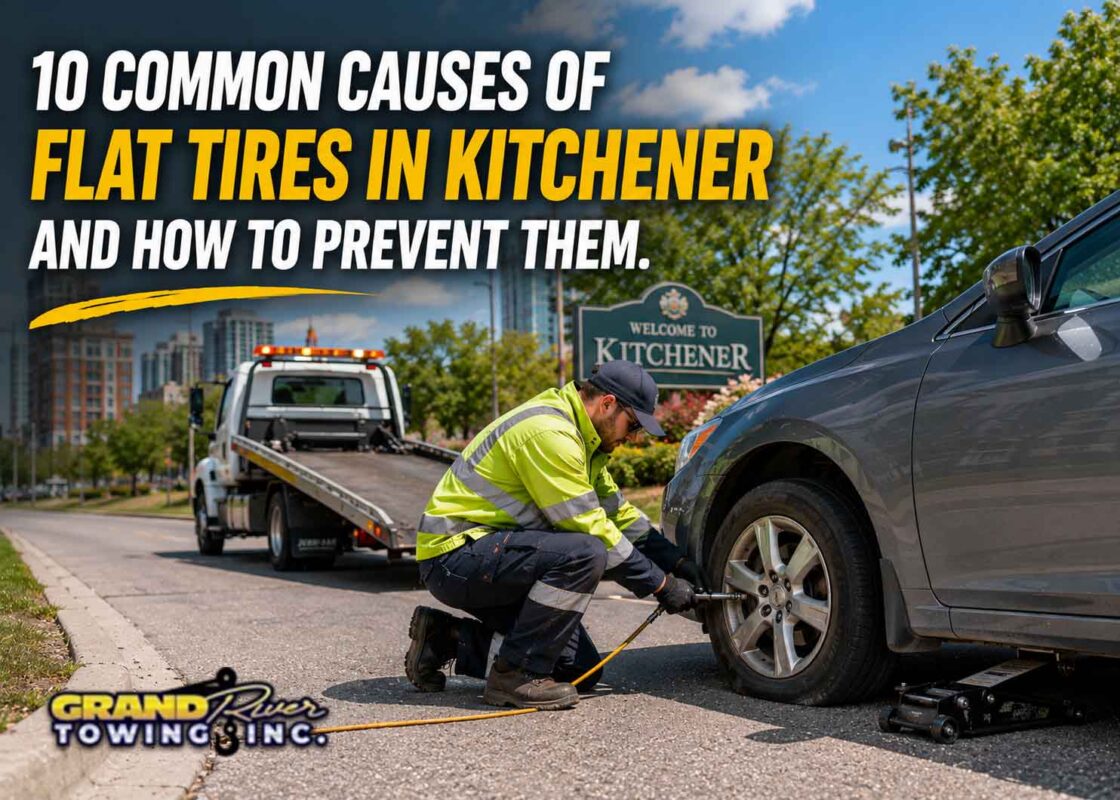
Grand River Towing provides flat tire repair and roadside tire assistance across Kitchener, Waterloo, Cambridge, and nearby communities. If a safe roadside change is not possible or no usable spare is available, towing may be the safer next step.
Overheating, Fluid Leaks, Belts, and Hoses
An overheating engine needs immediate attention. Continuing to drive can turn a cooling-system repair into serious engine damage.
Common warning signs include:
- The temperature gauge moves above its normal position.
- A temperature or coolant warning appears.
- Steam comes from under the hood.
- A sweet smell enters the cabin or surrounds the vehicle.
- Coolant is visible beneath the car.
- The heater suddenly blows cold air while the engine is hot.
Possible causes include low coolant, a leaking hose, radiator damage, a failed thermostat, a weak water pump, or a cooling-fan problem.
Pull over safely and switch off the engine if the temperature continues to rise. Do not remove a hot radiator or coolant cap. Pressurized coolant can cause severe burns.
Other fluids also need attention. Low engine oil can reduce lubrication. Brake-fluid loss may indicate a safety-critical leak. Transmission-fluid problems can affect shifting and vehicle movement.
Belts and hoses should be inspected for cracking, fraying, swelling, looseness, and leaks. A failed belt can stop the charging system, water pump, power steering, or other driven components, depending on the vehicle design.
A puddle under the car should not automatically be treated as harmless. Note its colour, location, and smell, then have the source identified.
Fuel, Ignition, and Electrical Common Car Problems
Some breakdowns happen because fuel or electrical power is not reaching the engine correctly.
The obvious example is running out of fuel. Fuel gauges can also become inaccurate, especially in older vehicles. Keeping the tank above a very low level gives you a useful margin during traffic delays, winter conditions, or unexpected detours.
Fuel-system problems may involve a pump, relay, filter, injector, sensor, or contaminated fuel. Ignition problems can come from worn spark plugs, failed coils, wiring faults, or control-system issues.
Possible symptoms include:
- The engine cranks but does not start.
- The vehicle stalls at stops.
- Acceleration becomes uneven.
- The engine misfires or shakes.
- Fuel consumption changes suddenly.
- The check-engine light flashes.
- The vehicle loses power under load.
A flashing check-engine light generally requires more urgent attention than a steady light because it may indicate an active misfire. Reduce load, stop driving if the vehicle is running poorly, and arrange an inspection.
Modern vehicles depend on sensors, wiring, fuses, relays, and control modules. Guessing at electrical problems often leads to unnecessary parts replacement. Proper testing is faster and usually less expensive.
Car Maintenance Guide for Preventing Breakdowns
The most useful vehicle maintenance tips are simple: follow the owner’s manual, inspect the vehicle between services, and do not wait for a component to fail completely.
Ontario’s Ministry of Transportation notes that maintenance schedules are generally based on time or accumulated mileage, whichever comes first. Routine work may include oil and filter changes, fluid checks, tire rotation, brake inspections, filter replacement, and scheduled belt service.
Use this practical car maintenance guide as a starting point.
Check Monthly
- Tire pressure and visible tire condition
- Engine oil level
- Coolant level when the engine is cold
- Windshield-washer fluid
- Exterior lights
- Battery terminals
- Signs of fluid leakage
Check Before a Longer Drive
- Tire pressure, including the spare
- Tread and sidewall condition
- Fluid levels
- Warning lights
- Wipers and washer operation
- Fuel level
- Emergency kit
- Phone charger
Follow the Manufacturer’s Schedule
Service intervals differ by vehicle, engine, age, and use. A vehicle driven on short trips, in stop-and-go traffic, through winter road salt, or while carrying heavy loads may need closer attention.
The owner’s manual remains the correct source for oil type, fluid specifications, timing-belt intervals, tire pressure, and scheduled inspections.
Act on Changes Early
Book an inspection when you notice:
- A new vibration
- Grinding, squealing, knocking, or clicking
- Reduced braking performance
- Hard starting
- Fluid consumption
- Steering changes
- Rising engine temperature
- Repeated warning lights
- Unusual exhaust smoke
- A burning or fuel smell
These warning signs do not identify the exact failed part. They tell you the vehicle needs attention.
Preventive Maintenance Versus Breakdown Repair
| Preventive Action | Problem It May Help Prevent |
| Battery and charging test | No-start condition |
| Tire-pressure and tread check | Flat tire, blowout, poor control |
| Cooling-system inspection | Engine overheating |
| Oil and fluid checks | Lubrication or hydraulic problems |
| Belt and hose inspection | Sudden accessory or cooling failure |
| Brake inspection | Reduced stopping ability |
| Diagnostic scan and testing | Unresolved engine or electrical faults |
Preventive service does not guarantee that a vehicle will never break down. It reduces avoidable failures and gives you more control over where and when repairs happen.
What to Do When Your Vehicle Breaks Down
Stay calm and focus on getting out of moving traffic.
Turn on your hazard lights. Move the vehicle as far off the roadway as possible if it can still be driven safely. Avoid stopping around a blind curve, narrow shoulder, or active traffic lane.
Ontario’s driver guidance advises motorists dealing with vehicle trouble to bring the vehicle to a safe stop off the road when possible. Drivers should also understand which towing company is attending and where the vehicle will be taken.
Once stopped:
- Apply the parking brake.
- Keep your hazard lights on.
- Stay aware of passing traffic.
- Do not stand between the vehicle and moving lanes.
- Note your road, direction of travel, nearest exit, address, or landmark.
- Explain the vehicle type and problem clearly when requesting help.
- Tell the dispatcher if the vehicle is in a dangerous position.
A jump-start, spare-tire installation, or minor roadside service may solve the immediate problem. Mechanical failure, collision damage, severe tire damage, or overheating may require towing.
Grand River Towing offers 24 hour roadside assistance for breakdown recovery in Kitchener, Waterloo, Cambridge, and surrounding areas. The company also provides light towing and flatbed transport when a vehicle cannot be driven safely.
Frequently Asked Questions
What are the most common car breakdown causes?
Frequent causes include weak batteries, alternator problems, flat or damaged tires, overheating, low fluids, broken belts, fuel-system faults, ignition problems, and electrical failures. Some happen suddenly, but many produce warning signs first.
Can regular maintenance prevent every breakdown?
No. New components can fail, road debris can damage tires, and unexpected electrical faults can occur. Regular maintenance reduces preventable breakdowns and helps identify worn parts before they stop working.
Should I drive after the engine temperature warning appears?
Pull over as soon as it is safe if the temperature remains high or continues rising. Driving an overheating vehicle can cause major engine damage. Switch off the engine and arrange roadside help.
What should I keep in my vehicle for a breakdown?
Carry a phone charger, flashlight, reflective warning device, blanket, gloves, basic first-aid kit, washer fluid, and vehicle documents. Check that the spare tire, jack, and wheel tools are present and usable.
Do I need towing if my vehicle still starts?
Possibly. A vehicle may start but still be unsafe because of overheating, tire damage, brake problems, fluid loss, collision damage, or severe warning lights. Describe the symptoms to the roadside provider and avoid driving if doing so may cause damage or create a safety risk.
How can I request towing in Kitchener, Waterloo, or Cambridge?
Provide your location, direction of travel, vehicle type, current symptoms, and preferred destination. For towing or roadside help, contact Grand River Towing or call +1 (519) 729-0982. The company accepts requests for service across Kitchener, Waterloo, Cambridge, and surrounding Waterloo Region communities.
Catching a weak battery, damaged tire, coolant leak, or worn belt early can prevent a long delay on the roadside. Still, not every failure can be predicted. If your vehicle becomes unsafe to drive, stop in a secure location and contact Grand River Towing for 24/7 towing or roadside assistance.